
On-site hard drive shredding
The truck comes to your dock. Drives are degaussed on an NSA-listed degausser, shredded on an industrial hard drive shredder, and recycled, while your staff watch and a certificate lists every serial number. Anywhere in the lower 48; next-day in most of Ohio and the neighboring states.
What hard drive shredding is, and what it is not
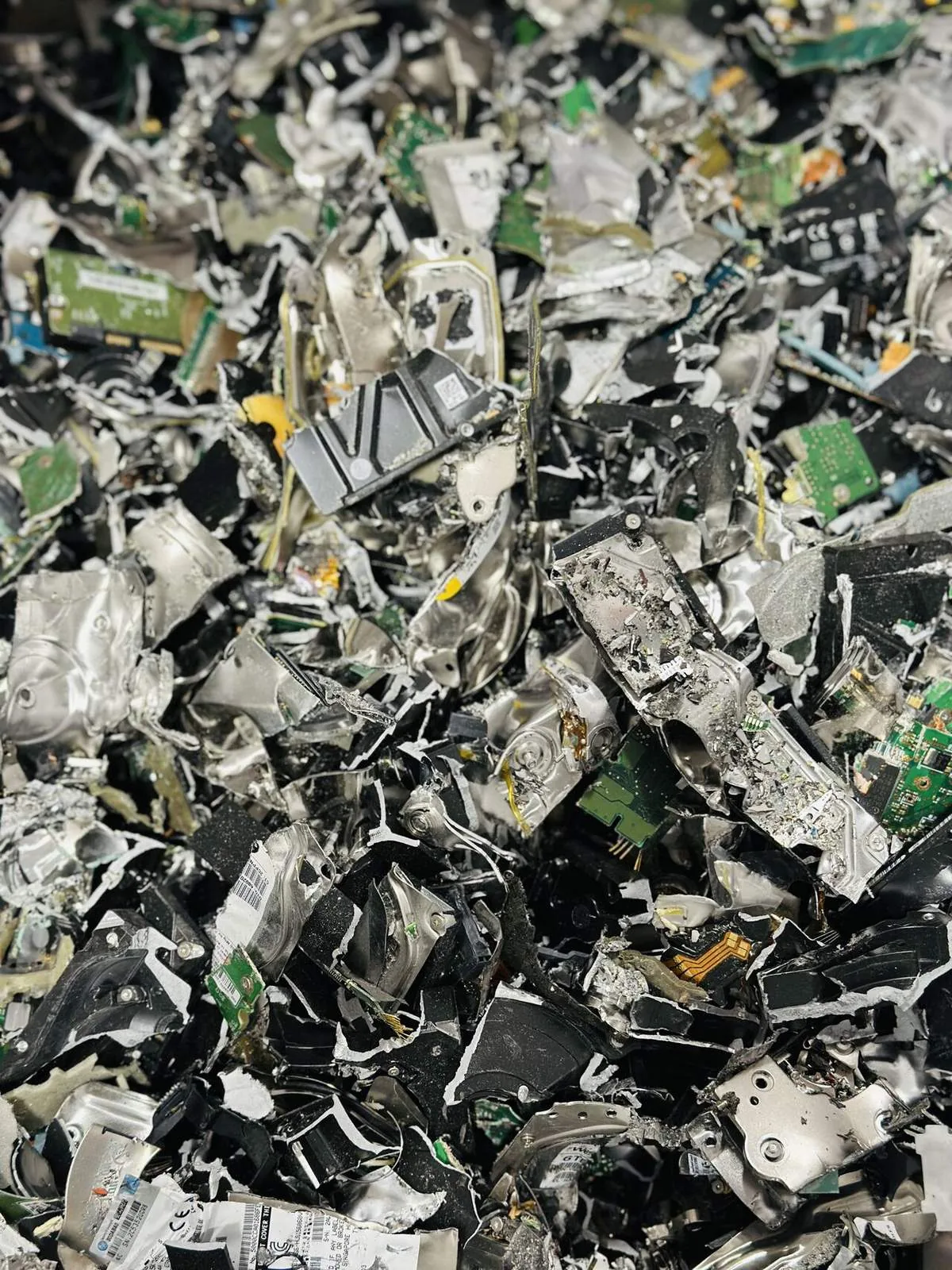
Shredding a hard drive means feeding it through hooked, heat-treated steel cutters until the housing, platters, heads, and circuit board come out in pieces. It is a NIST SP 800-88 Rev. 2 Destroy method: the media is physically damaged so the data cannot be read by any known technique. It is not a wipe, and it does not depend on the drive working, on a command being supported, or on a log being complete. When it is done, you can look into the bin and see the result.
For classified magnetic drives, shredding on its own is not enough. NSA/CSS Policy Manual 9-12, reissued in February 2026, requires that the drive first be degaussed on a degausser from the NSA's Evaluated Products List and then deformed, and it states that any hard drive shredder is approved for the deformation step once the drive has been degaussed. That two-step process is what runs on our truck for every magnetic drive, classified or not, because the degausser is already on the belt.
What we shred
3.5-inch desktop and server drives, 2.5-inch laptop drives, and the drives inside the equipment you have not opened: workstations, servers, NAS units, DVRs, copiers, and printers. Hybrid drives, which carry solid-state cache on the circuit board, have the board separated and disintegrated as solid-state media per the 2026 manual. Heat-assisted magnetic recording (HAMR) drives, identifiable by the Class 1 laser statement on the label, shred normally under NIST 800-88 for unclassified data; for classified data the NSA allows only incineration, so we set them aside for your security officer rather than run a process that would not work.
How a visit works
- You tell us what you have. Drive count, media mix, the standard you are held to, and where you are. We come back with a custom quote, and the quote is the price.
- The truck arrives. Your staff bring the drives out, or we pull them from racks and closets with you. Serial numbers are captured on request, or included for larger jobs.
- Degauss, then shred. Each drive crosses the Data Security LM-1 degausser and drops into the Allegheny 5HD3 shredder, up to 600 drives an hour per shredder, about 4,000 a day per trailer. Your staff watch every one.
- You keep the certificate. The Certificate of Destruction names the method, the machine, the date, and each serial number, with recycling documentation from our R2-certified partners.
What happens to the pieces
Nothing goes to a landfill. Aluminum housings, steel, and platter fragments are separated for scrap. Circuit boards, and the particles from any solid-state components, go to a domestic smelter for gold, silver, copper, and palladium. Every downstream step runs through R2-certified partners, and we make every effort to keep the material in the United States.
Standards this satisfies
NIST SP 800-88 Rev. 2 Destroy for every drive. NSA/CSS 9-12 for classified magnetic media, using the degauss-then-deform sequence the manual requires. HIPAA, CJIS, GLBA and the FACTA Disposal Rule, CMMC and NIST 800-171 requirement 3.8.3, IRS Publication 1075, and FERPA, depending on who you are. How each standard maps to the method.
By mail
Unclassified media can travel by tracked carrier. Per-item prices, $59 minimum, prepaid label included under 10 lb. Price a box.
- Hard drive, 3.5-inch, by mail$8
- Hard drive, 2.5-inch, by mail$8
Where we do it
Anywhere in the lower 48, next-day in our closest metros. Columbus, Cleveland, Akron, Canton, Toledo, Youngstown, Dayton, Cincinnati, Pittsburgh, Erie, Wheeling, Morgantown, and 29 more.
Who uses this
Healthcare, Law enforcement and courts, Defense contractors, Federal, state, and local government, Education, Financial services, Data centers and colocation, Aerospace and defense suppliers.
Other services
Questions
Do you shred the drive whole, or open it first?
Whole. The shredder takes the drive as it comes out of the computer. Hybrid drives are the exception: the circuit board is separated first so its solid-state cache can be disintegrated to solid-state requirements.
Why degauss if you are going to shred anyway?
Because for classified magnetic media the NSA requires both, and because the degausser is already running. Degaussing erases the data field; shredding makes it permanent and visible. For unclassified work shredding alone meets NIST 800-88 Destroy, and we still degauss first because it costs nothing extra.
Can we watch?
Yes, and we encourage it. Witnessed destruction is the reason the truck comes to you. Bring the security officer, the records manager, or the auditor.
How many drives can you do in a day?
Up to 600 an hour per shredder, about 4,000 a day per trailer. A data center floor is a scheduled run, sometimes over consecutive days.
What does it cost?
On-site jobs are quoted individually from drive count, media mix, standard, and distance, and the quote does not change on the day. By mail, hard drives are $8 each with a $59 minimum. What moves the number.
What if we only have a few drives?
In our next-day metros there is no minimum, and a single server is a job. For a handful of drives anywhere, Shred by Mail is usually cheaper: $8 per drive, label included under 10 lb.